Smart Farming - The Future of Automated Agriculture
Smart Farming uses technologies such as AI, sensors, and predictive maintenance (PdM) to make agriculture more efficient and sustainable.
For Busy Readers
- Definition & Goals: Smart Farming, also known as Agriculture 4.0, uses technologies such as sensors, AI, IoT, and digital twins to make agricultural processes more efficient, sustainable, and resource-friendly.
- Technologies & Applications: From self-driving tractors and drones to automated irrigation and feeding systems, modern technologies improve yields and reduce environmental impact.
- Predictive Maintenance (PdM): AI-powered predictive maintenance minimizes downtime, reduces costs, and improves the reliability of machinery and equipment.
- Benefits & Challenges: While Smart Farming improves economic viability, ecology, and working conditions, high investment costs, IT complexity, and rural network infrastructure pose hurdles.
Agriculture is facing enormous challenges: a growing global population, climate change, and labor shortages require innovative solutions. By using cutting-edge technologies, Smart Farming offers the opportunity not only to make processes more efficient but also to operate more sustainably. Combined with predictive maintenance (PdM), enabled by intelligent technologies, costs can be reduced and the reliability of machinery and equipment increased. But what exactly is behind the Smart Farming concept, and what other opportunities do digitalization and automation offer for the future of agriculture? You will find the answers in this article.
What is Smart Farming?
Smart Farming, also known as Agriculture 4.0, describes the use of modern technologies such as sensors, the Internet of Things (IoT), artificial intelligence (AI), and data analytics to make agricultural processes more effective. The goal is to increase productivity, optimize resource usage, and promote sustainability. Innovative approaches such as digital twins and machine learning are used to support decision-making based on precise data. The objective is to produce more with fewer resources while protecting the environment. One starting point for more sustainable agriculture is predictive maintenance, which uses early warning systems to ensure the operation of critical equipment and systems and minimize downtime.
Digital Twin: A digital twin is a virtual, digital replica of a real object, system, process, or entire facility. It is based on real-time data and simulations and is used to better understand, monitor, improve, or optimize its physical counterpart.
Smart Farming: Technological Foundations and Examples
Sensor Technology
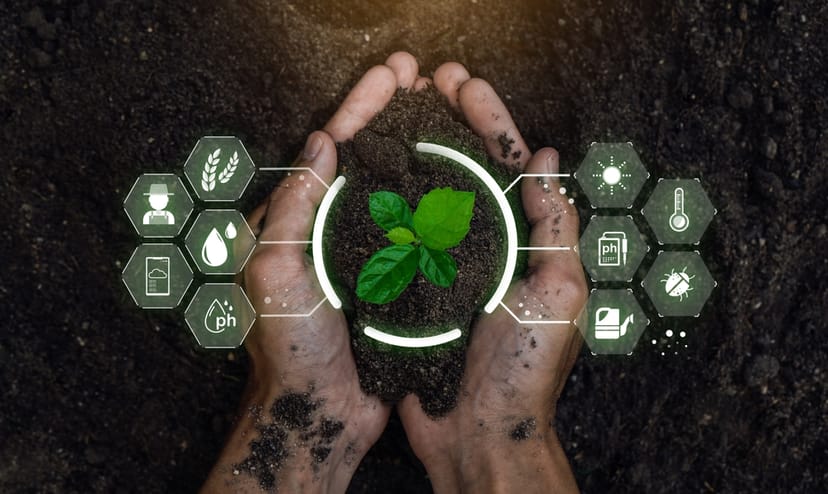
The field of sensor technology has seen enormous development in recent years. Modern sensor systems are capable of continuously monitoring a wide variety of parameters on the farm. They capture not only soil moisture and quality but also important weather conditions directly on-site. Furthermore, special sensors allow for the precise observation of factors such as plant growth and animal health.
Artificial Intelligence and Machine Learning
Modern AI systems process the collected sensor data and create precise predictive models from it. These allow farmers to determine optimal sowing and harvesting times, among other things, and to detect potential diseases in plants and animals at an early stage. Furthermore, artificial intelligence (AI) can help optimize resource management and generate reliable yield forecasts for the upcoming season.
In the area of Predictive Maintenance (PdM), AI continuously analyzes machine data to detect signs of wear or malfunctions and to plan maintenance measures in a targeted manner. Unplanned downtime can thus be drastically reduced.
Agricultural Automation
The use of autonomous systems is also advancing rapidly in agriculture. Self-driving tractors and harvesters are increasingly taking over field work, while drones monitor fields from the air. In modern stables, robots are increasingly used to take care of cleaning and maintenance. These systems work precisely, do not tire, and can be used around the clock. PdM systems can continuously monitor the equipment to prevent failures before they occur.
Application Areas of Smart Farming
Optimized Irrigation
Intelligent irrigation has become a core area of Smart Farming. Modern systems use soil sensors to continuously measure moisture and automatically regulate water supply. This demand-based supply not only optimizes plant growth but also contributes significantly to water conservation. The technology also takes weather forecasts into account and adjusts irrigation accordingly.
Automated Livestock Farming
Modern livestock farming has fundamentally changed due to Smart Farming technologies. In contemporary stables, automatic feeding systems ensure that animals are provided with what they need. At the same time, sensors continuously monitor their health and can provide early warnings of changes. Intelligent climate control systems ensure optimal environmental conditions, while milking robots take over time-consuming manual milking work.
Drones and Satellite Technology
Aerial surveillance using drones and satellites opens up completely new perspectives in agriculture. These technologies enable precise mapping of fields and can detect pest infestations or diseases at an early stage. The collected data helps optimize fertilization and enables more accurate yield estimates. The combination of satellite data and drone footage creates a comprehensive picture of the agricultural operation.
Benefits of Smart Farming
Economic Benefits
The implementation of Smart Farming technologies leads to a significant reduction in operating costs through optimized resource use. By using PdM in agriculture, expensive repairs are minimized and harvest losses due to sudden and unexpected machine failures are prevented. Farmers benefit from higher yields thanks to more precise cultivation methods and improved animal health.
Ecological Benefits
Smart Farming makes an important contribution to environmental protection. Reduced water consumption through precise irrigation systems conserves valuable resources. The targeted use of fertilizers and the minimization of pesticides reduce the burden on soil and groundwater. In addition, increased efficiency leads to a reduction in CO2 emissions in the agricultural sector.
Social Benefits
The digitalization of agriculture also has positive effects on working conditions. Heavy physical labor is increasingly being taken over by machines, while new, attractive job profiles are developing as part of the digitalization of agriculture. Automation enables a better work-life balance for farmers and their employees. At the same time, the quality of produced food increases due to more precise production methods.
Challenges and Solutions
Technical Challenges
The introduction of Smart Farming technologies presents farmers with various challenges. The high investment costs for modern systems can be a hurdle, especially for smaller farms. The complexity of the systems requires specific know-how in information and communication technologies, while issues of data security are becoming increasingly important. Another challenge is the often-lacking network coverage in rural areas.
Solution Strategies
To overcome these challenges, various solution strategies have been developed. Government and private funding programs support farmers in the digitalization of their operations. Extensive training and further education offers help in acquiring the necessary skills. The development of special IT security concepts addresses data protection concerns, while the continuous expansion of digital infrastructure improves connectivity in rural areas.
Implementation of Smart Farming
First Steps
The successful introduction of Smart Farming technologies begins with a thorough inventory and analysis of operational requirements. Based on this, concrete goals are defined and a step-by-step implementation plan is developed. The introduction of new technologies takes place gradually so as not to overwhelm employees and to be able to learn from experience. Continuous evaluation of the measures makes it possible to adjust the implementation process if necessary.
PdM in Agriculture: Practical Example
The technology company Continental, together with the agricultural machinery manufacturer CLAAS, developed an intelligent drive belt for combine harvesters.
Benefits:
- Early detection of potential defects
- Avoidance of unplanned downtime
- Proactive service measures by dealers
In the future, CLAAS dealers will be able to proactively approach customers and schedule necessary service appointments in advance. Through the use of Predictive Maintenance, CLAAS was not only able to increase the reliability of its machines but also to reduce operating costs and increase productivity. This illustrates the enormous potential of PdM in modern agriculture.
Conclusion
The continuous development of 5G, AI, sensor technologies, and robotic systems enables more precise, efficient, and resource-friendly farming. At the same time, this progress meets the growing desire for sustainable and transparent production and creates space for new working models that appeal in particular to young, tech-savvy people. Concepts such as urban farming also expand the spectrum of possible applications.
Although the initial implementation can be associated with challenges, the potential to create long-term benefits both economically and ecologically outweighs them. Smart Farming is therefore not only an answer to the pressing current challenges but a pioneering model for the agriculture of the future.
Frequently Asked Questions
How high are the investment costs for Smart Farming?
The costs for Smart Farming technologies vary significantly depending on the scope of implementation. While entry-level solutions can be realized for a few thousand euros, comprehensive systems can require investments of several hundred thousand euros. However, many countries offer special funding programs that support farmers in the digitalization of their operations.
What prior knowledge do farmers need for Smart Farming?
Although basic IT skills are an advantage, they are not strictly necessary for getting started with Smart Farming. What is more important is the willingness to engage with new technologies. Most providers of Smart Farming solutions offer comprehensive training programs and technical support.
How does Smart Farming affect the environment and the future of agriculture?
Smart Farming has predominantly positive effects on the environment. Through the precise use of resources such as water, fertilizers, and pesticides, environmental impact is significantly reduced. In addition, optimized processes contribute to a reduction in energy consumption and CO2 emissions.
Is Smart Farming also suitable for smaller farms?
Smart Farming is not reserved for large agricultural operations. There are now numerous scalable solutions that are also economically sensible for smaller farms. The entry can take place gradually, starting with individual technologies that promise the greatest immediate benefit.
How secure is the collected data?
Modern Smart Farming systems have extensive security features to protect the collected data. The choice of trustworthy providers and the implementation of appropriate security concepts are crucial. Regular updates and employee training also contribute to data security.