For those in a hurry
- Structured E-Invoicing Formats: XML-based e-invoices contain all mandatory invoice details in a machine-readable and standardized way, which reduces errors and simplifies invoice exchange.
- Automation & Efficiency: XML-based e-invoices like ZUGFeRD, Factur-X, and XRechnung enable fully seamless and automated invoice processing – less manual work, more efficiency!
- Flexible Integration: Thanks to flexible connectors, ZUGFeRD and XRechnung can be seamlessly integrated into existing ERP systems, enabling the automatic creation and processing of invoices.
- Complete Solution Without System Replacement: With cloud-based e-invoicing software, companies can create and receive digital invoices in compliance with GoBD without requiring new IT systems.
The automated processing of electronic invoices in formats like ZUGFeRD, Factur-X, and XRechnung significantly simplifies the often complex exchange of invoices between companies. In this article, we show you how to import and create digital invoices in these XML-based standards without having to implement a new IT system. Discover the benefits of e-invoicing and how you can profit from it!
The Challenge of Invoice Processing
Recording invoices electronically and exchanging them with business partners is a standard business procedure. Unfortunately, this process is often complicated by media discontinuities—for example, when invoices are converted into formats like PDF, TIFF, or even paper. Invoice recipients then often have to transform them back into digital information through tedious technical or even manual efforts. Consistent electronic processing of these e-invoices, which functions without media breaks, saves both time and money.
What are structured electronic invoice formats?
Structured e-invoicing formats are standardized data exchange formats based on XML. These formats enable the automated processing of invoice data without manual intervention, thereby facilitating the entire invoicing process between companies. They contain all mandatory invoice information in a uniform, machine-readable format. This allows for a seamless transfer and automated processing of invoice data between the issuer and the recipient. Consequently, companies can work more efficiently, reduce errors, and increase transparency in their financial operations.
E-Invoicing: ZUGFeRD, Factur-X, and XRechnung Formats
To simplify invoice exchange, the electronic invoicing formats ZUGFeRD, Factur-X, and XRechnung were developed. They allow for electronic invoicing in a standardized XML format that is both human-readable and machine-processable.
What is ZUGFeRD?
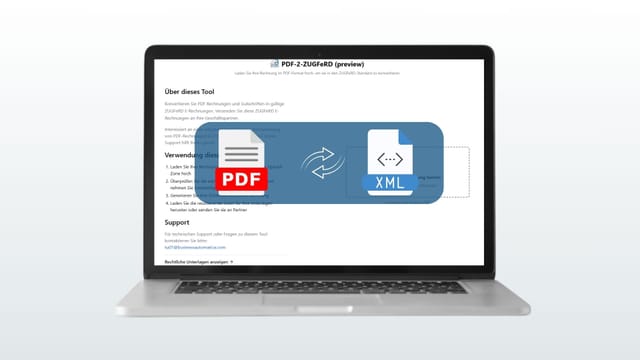
ZUGFeRD (Central User Guide of the Forum for Electronic Invoicing Germany) is a hybrid format that, starting with version ZUGFeRD 2.1.1, complies with the requirements of the European standard EN 16931. It combines structured data, such as XML, with a PDF document, making the invoice both machine-readable and understandable for humans. Furthermore, the structures and fields of the XML file are standardized and uniformly named, allowing for clear assignment and processing of every piece of information during import.
What is Factur-X?
Factur-X is also a hybrid invoice format that continues the advantages of ZUGFeRD and is applicable internationally. It also enables the simultaneous exchange of structured invoice data (in XML format) and a readable PDF document. Overall, Factur-X offers expanded possibilities for electronic invoice exchange, especially in cross-border business relationships. It also complies with the EN 16931 standard and is considered an accepted format in Germany.
What is XRechnung?
XRechnung is also a standardized XML format, but unlike the ZUGFeRD standard, it does not contain a graphical component (PDF). If a human wants to open and read an XRechnung, they must either work with the XML document and understand/interpret the fields, or use a service—usually a website—that can at least structurally prepare the XRechnung thanks to its standard. XRechnung also complies with the European standard EN 16931 and is mandatory for all public sector clients.
All three formats are compliant and meet the requirements of the e-invoicing mandate in Germany from 2025 onwards, provided they are applied correctly and legal standards are maintained.
Challenges in Integration
Some companies already create their invoices electronically via web interfaces or software solutions like lexoffice or sevDesk, which support the XRechnung standard. However, for companies that need to process large volumes of invoices per month, seamless integration into existing ERP systems is essential to correctly transmit and receive invoice data in a structured electronic format.
In these cases, a software solution is required that can be seamlessly integrated into the leading ERP system, allowing invoice creation to be triggered using data from the ERP system. Meanwhile, the software handles the correct formatting and transmission of the ZUGFeRD or XRechnung files.
If you receive a ZUGFeRD or XRechnung yourself, the same software should be able to transfer the invoice data directly into the ERP system without manual intervention. Whether the invoice arrives via email, interface, or file upload should be irrelevant, as long as it can be received and processed. Invoice data must reach the ERP system immediately and without errors, as payment terms, cash discounts, and deadlines start from the moment of receipt, not from the moment of processing.
Automation through Integration and Standardization
Automated data exchange between systems requires integration that assumes a deep understanding of the desired workflow. Invoice processing, as a critical business process, must be precise and traceable to ensure cash flow. Standards like XRechnung and ZUGFeRD provide a foundation, but the true benefit only arises through full workflow automation. A flexible connector for these standards can optimize the invoice processing workflow and better meet legal requirements.
Cloud-based E-Invoicing: Your All-in-One Solution
Numerous available solutions focus primarily on creating XRechnung or ZUGFeRD via web interfaces, while the receipt and import of these invoices remain unresolved. Especially with high invoice volumes, it makes sense to handle this directly from the ERP system. We offer a platform-independent solution that can be seamlessly integrated into various systems.
With our cloud-based e-invoicing software, you can create and receive e-invoices effortlessly and without system modifications. Experience GoBD-compliant archiving, automated processing, and cost efficiency all in one. Book a free demo and learn how our solution can simplify your processes!
Automated Creation and Processing
For fully automated electronic processing of ZUGFeRD, Factur-X, and XRechnung, we have developed a solution that can be integrated as a module into any common integration platform such as SAP Integration Suite, Workato, or Oracle Integration Cloud. Thanks to APIs and connectors, our digital invoice converter fits into any middleware. This optimizes both the creation and the reading of invoices. With our complete solution, the entire process—from sending the invoice to importing the data—can be automated and free of media breaks.
Flexible Customization and Control
When creating a ZUGFeRD invoice, companies can flexibly adapt the layout of the PDF invoice to their corporate identity. The invoice converter delivers the finished PDF/A invoice along with the embedded XML file, which can be stored on a file server or displayed in MS Teams or Slack before being sent. There are no limits to your workflow preferences.
All steps can also be documented in a logging app to maintain full transparency over all invoice creation activities at all times.
Importing ZUGFeRD and XRechnung is also automated. The XML data is parsed according to the standard and transferred to the ERP system. The PDF/A of the ZUGFeRD invoice is separated so that the XML data can be machine-processed, while the PDF remains accessible to the user via a link. The PDF can be stored on a file server or cloud storage, and the link to the human-readable document can be passed to the downstream system (e.g., MS Dynamics F&O) as a URL.
Conclusion
The introduction of e-invoicing is more than just a legal necessity—it offers companies the opportunity to optimize their processes and reduce costs. XRechnung, ZUGFeRD, and Factur-X significantly facilitate the exchange of invoices, but it is the complete integration into an automated workflow that yields the greatest efficiency gains. A flexible connector for creating and processing these formats ensures that companies not only meet the requirements of the European standard EN 16931 but also qualitatively improve their processes.
Frequently Asked Questions
When does e-invoicing become mandatory?
The obligation for e-invoicing comes into force for all companies in the B2B sector starting January 1, 2025, to digitize invoice exchange and make tax processes more efficient.
What are the advantages of electronic invoicing?
Electronic invoicing enables faster and more efficient invoice processing, reduces costs by eliminating paper invoices, and improves the readability and traceability of issued invoices.
Which formats are recommended for e-invoices?
The recommended formats are based on national and international standards and ensure that invoices are machine-readable and compliant with legal requirements. For Germany, the primary recommended formats are ZUGFeRD, which combines PDF and XML data, and XRechnung, which was developed specifically for exchange with public administrations.
Can paper invoices also be processed as e-invoices?
Yes, scanned paper invoices or PDFs can be processed as e-invoices, although this is not optimal for machine processing. It is recommended to issue e-invoices in a structured format.
What are the requirements for the readability of an e-invoice?
The readability of an e-invoice must be guaranteed to enable electronic processing in accordance with the EU directive. This means the invoice must be in a structured format that is understandable for both humans and machines.
What is EDIFACT (or EDI for short)?
EDIFACT (Electronic Data Interchange For Administration, Commerce and Transport) is an internationally standardized data format for the electronic transmission of structured business data, developed by the UN (United Nations). Unlike hybrid formats like ZUGFeRD and Factur-X, which combine XML data with a readable PDF, EDIFACT is based on purely text-based datasets specifically structured for machine exchange. This makes it particularly suitable for extensive, automated transactions and international data exchange, such as between companies and authorities worldwide.