For those in a hurry
- Connected AI instead of isolated solutions: Learn how companies are overcoming fragmented AI landscapes and achieving true automation with MCP and A2A.
- From theory to practice: Practical examples show how AI agents are already monitoring inventory, autonomously triggering orders, and automating supply chains today.
- Security and standardization: Learn how standardized protocols like MCP and A2A ensure not only efficiency but also maximum security.
- Future-proof AI architectures: Discover why MCP and A2A form the foundation for scalable, adaptable, and sustainable AI ecosystems.
Efficiency, speed, and automation are no longer optional in business—they are mandatory. However, many AI solutions hit a wall: they operate in isolation, are difficult to integrate, and lack adaptability. What is missing is a common language between them. This is exactly where two forward-looking technologies come into play:
- Agent2Agent Protocol (A2A) – for communication and collaboration between different AI agents
- Model Context Protocol (MCP) – for intelligent access to external systems and resources
Together, they create the foundation for scalable, connected AI ecosystems—paving the way for intelligent process automation in companies.
What is the Agent2Agent Protocol (A2A)?
The Agent2Agent Protocol (A2A) enables direct communication between different AI agents. Instead of working in isolation, agents can exchange information, delegate tasks, and jointly handle complex processes.
Advantages of A2A
- Collaboration: Agents with different specializations can work together
- Scalability: New agents can be easily integrated into existing networks
- Flexibility: Dynamic adaptation to changing requirements
MCP and A2A in Interaction
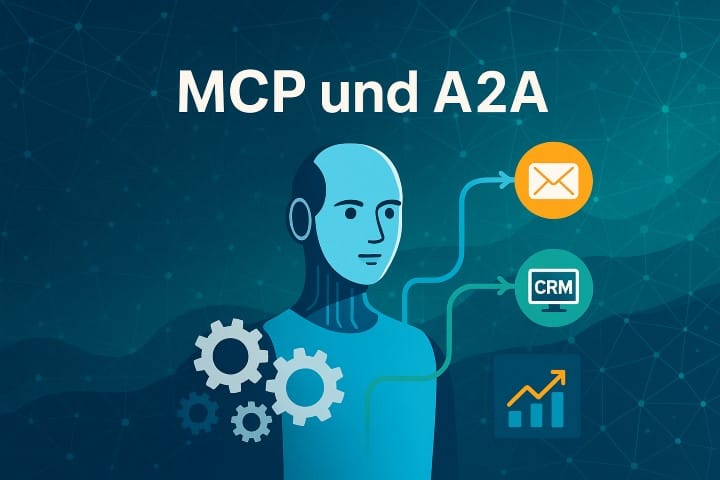
While MCP standardizes access to external tools and data sources, A2A enables communication between the agents themselves. Together, they form a powerful ecosystem:
- MCP: Agents access CRM, ERP, databases, and other systems
- A2A: Agents coordinate their actions and share results
Practical Examples
Automated Supply Chain
- An inventory monitoring agent detects low stock levels
- It communicates via A2A with an ordering agent
- The ordering agent uses MCP to access the ERP system and trigger an order
- A notification agent informs the team via email
Intelligent Document Management
- A reception agent classifies incoming documents
- Relevant documents are forwarded to specialized agents via A2A
- These agents use MCP to enter information into various systems
Security and Governance
Both protocols place great emphasis on security:
- Authentication: Agents must authenticate themselves to one another
- Authorization: Granular access controls for every agent
- Audit Trail: All actions are logged
Conclusion
MCP and A2A are not competitors; they complement each other perfectly. Together, they enable the construction of connected AI ecosystems that go far beyond the capabilities of individual agents. Companies that adopt these protocols early will gain a significant competitive advantage.